Sexual violence in Utah is not an isolated phenomenon but a patterned outcome of cultural, social, and institutional dynamics. It is time to consider whether upstream conditions within religious and conservative environments can unintentionally contribute to harm. By integrating research with theological reflection, this piece invites Latter‑day Saints to consider how building Zion requires confronting the cultural norms that allow violence to persist.
For many Latter‑day Saints, sexual violence feels like something that happens “out there”—in places where families are unstable, communities are fractured, or moral values have eroded. Utah’s strong religious identity, high rates of marriage, and emphasis on family life seem to promise protection. Yet the data tell a different story: Utah consistently reports higher‑than‑national‑average rates of rape, child sexual abuse, and other forms of gender‑based harm. [1]
This reality is painful. It disrupts cherished assumptions about who we are and what our communities represent. But as disciples of Jesus Christ, we are commanded to “deal justly, love mercy, and walk humbly” (Micah 6:8). Humility requires truth‑telling. Mercy requires compassion for survivors. Justice requires confronting the conditions that allow harm to take root, even when those conditions exist within our own congregations, families, and cultural norms.
This article draws on my recent white paper, “The Roots of Sexual Violence in Utah: A Framework for Understanding Harm, [2] published through the Utah Women & Leadership Project (UWLP) housed at Utah State University. It synthesizes decades of research and more than twenty conceptual models to explain how sexual violence develops, escalates, and becomes normalized. Here, I adapt that work specifically for a Latter‑day Saint audience. My purpose is not to criticize the Church or its members. My purpose is to help us see clearly, act courageously, and build Zion more faithfully.
Sexual violence cannot be understood solely as an individual transgression; it is a systemic outcome shaped by cultural norms, social structures, and power dynamics. [3] If Zion is to be a place of genuine safety, we must examine these dynamics with clarity and intention—and commit ourselves to changing the conditions that allow harm to persist.
My Perspective & Faith Context
The Latter‑day Saint Church—like most faith traditions—condemns abuse in every form. The Church states clearly that “the Lord condemns abusive behavior in any form—including neglect and physical, sexual, or verbal abuse. Most abuse violates the civil laws of society.” [4] Church doctrine further teaches that “abuse in any form is sinful, tragic, and in total opposition to the teachings of the Savior.” At the same time, research is clear that communities with stronger patriarchal norms tend to experience more problems with misuse of power, coercion, and sexual violence. [5] Recognizing these patterns is not an attack on faith; it is an effort to protect individuals and strengthen families—goals that align with the teachings of the gospel.
My understanding of abuse is also shaped by the teachings of the New Testament, which consistently reject the attitudes and behaviors that cause harm. The King James text teaches that relationships must be rooted in love, honor, and gentleness—not domination or cruelty. Paul instructs, “Husbands, love your wives, and be not bitter against them” (Colossians 3:19), and warns parents not to provoke or discourage their children (Colossians 3:21). The Savior’s followers are told to put away “bitterness, and wrath, and anger, and clamour, and evil speaking” (Ephesians 4:31) and to be “kind one to another” (Ephesians 4:32). Peter adds that husbands must give “honour unto the wife” (1 Peter 3:7), and James teaches that anger and explosive behavior are incompatible with God’s will (James 1:19–20). Perhaps most clearly, Paul’s description of Christlike love—patient, kind, not easily provoked, and never seeking to harm (1 Corinthians 13:4–7)—leaves no room for abusive behavior of any kind. These teachings make it clear that abuse is not only harmful—it is fundamentally incompatible with the gospel of Jesus Christ.
Yet, as decades of research make clear, faith‑based communities often contain many of the upstream conditions that allow sexual violence to take root, including patriarchal norms, gender inequity, male privilege, sexism, and traditional gender roles. These patterns do not arise because people are malicious; they arise because cultural and religious systems can unintentionally reinforce power imbalances and discourage open discussion.
As I wrote in a Utah News Dispatch commentary earlier this year, violence against women is “one of the most silenced social issues,” [6] and that silence is often driven by discomfort, fear of disrupting social harmony, and the desire to protect institutions from reputational harm. When violence “hits close to home”—inside families, congregations, and trusted circles—communities often shut down rather than confront the possibility that respected individuals may be responsible. These dynamics help explain why patriarchal environments, including some faith‑based settings, can become vulnerable to misuse of power and sexual abuse. This is a hard truth for many to hear, but avoiding it only deepens the silence that allows harm to continue.
In many organizational and social‑change frameworks, raising awareness is the essential first step toward meaningful transformation. The same is true for reducing sexual violence: we cannot change what we refuse to see. Silence does nothing to protect individuals or communities. If anything, it allows abuse to deepen and escalate. Faith‑based congregations offer countless positive benefits, and that is one reason I remain actively engaged in my own religious community. Yet to become more Christlike—as individuals and as congregations—we must be willing to confront the roots of sexual violence, including the cultural and structural factors that allow it to persist. The same expectation applies to every faith community, regardless of tradition.
As I have written elsewhere, [7] silence often takes hold because the truth is uncomfortable, because people fear disrupting what they perceive to be social harmony, or because acknowledging harm feels like a threat to the institutions they love. Avoiding difficult topics is not the answer. Tackling complex subjects that affect people’s lives and their safety directly, with courage and compassion, is the only way forward. If we want our faith communities—and all our communities—to be safer and more aligned with our highest values, whether those values are rooted in the teachings of Jesus Christ, another faith tradition, or a secular moral framework, we must be vigilant and honest, willing to address the conditions that allow abuse to take root.
For several years, I have felt the call to write the white paper that this article is based upon, but it is a difficult topic, and I had postponed the writing more than once. I knew the information would be hard for many to hear, and that many would disregard it. Yet if we do not learn where violence is coming from, we cannot do better.
Can we build a society that is both deeply religious and also one of the safest places in the nation for women, children, and families? That is the question we face. I believe the answer is yes—but it will require honest work and collective courage. If we truly care about our daughters, granddaughters, sisters, neighbors, and friends, then we must lean in, learn what is happening, and understand our part in shifting the conditions that allow violence to persist. A question I frequently pose in my public work is “Why are we not moving heaven and earth to protect our children and families?” Learning and taking action can begin now. Violence and abuse thrive in darkness. The light of intelligence and right action, fueled by courage and honesty, allows us to vanquish violence and create a culture that sustains all its members.
The Utah Sexual Violence Pyramid: A Framework for Understanding Harm
Understanding the theological foundations for rejecting abuse provides essential context for examining how sexual violence develops within broader cultural systems. The Utah Sexual Violence Pyramid offers a structured way to analyze these dynamics.
The research is clear: sexual violence exists on a continuum, not as isolated incidents. [8] It grows from the ground up—from attitudes and beliefs, to verbal expressions, to harassment and coercion, to assault, and ultimately to lethal violence. These behaviors are connected. The lower tiers create the cultural conditions in which more severe harm becomes possible.
To help Utahns understand this continuum, I synthesized the Utah Sexual Violence Pyramid, a five‑tier model that explains how harm escalates. Similar models are used throughout the world, but I integrated the strongest research and selected the language and elements specifically for Utah’s cultural and religious context, including the environment of The Church of Jesus Christ of Latter‑day Saints (see Figure 1). More detail on the methodology can be found in the full white paper.
Figure 1. The Utah Sexual Violence Pyramid
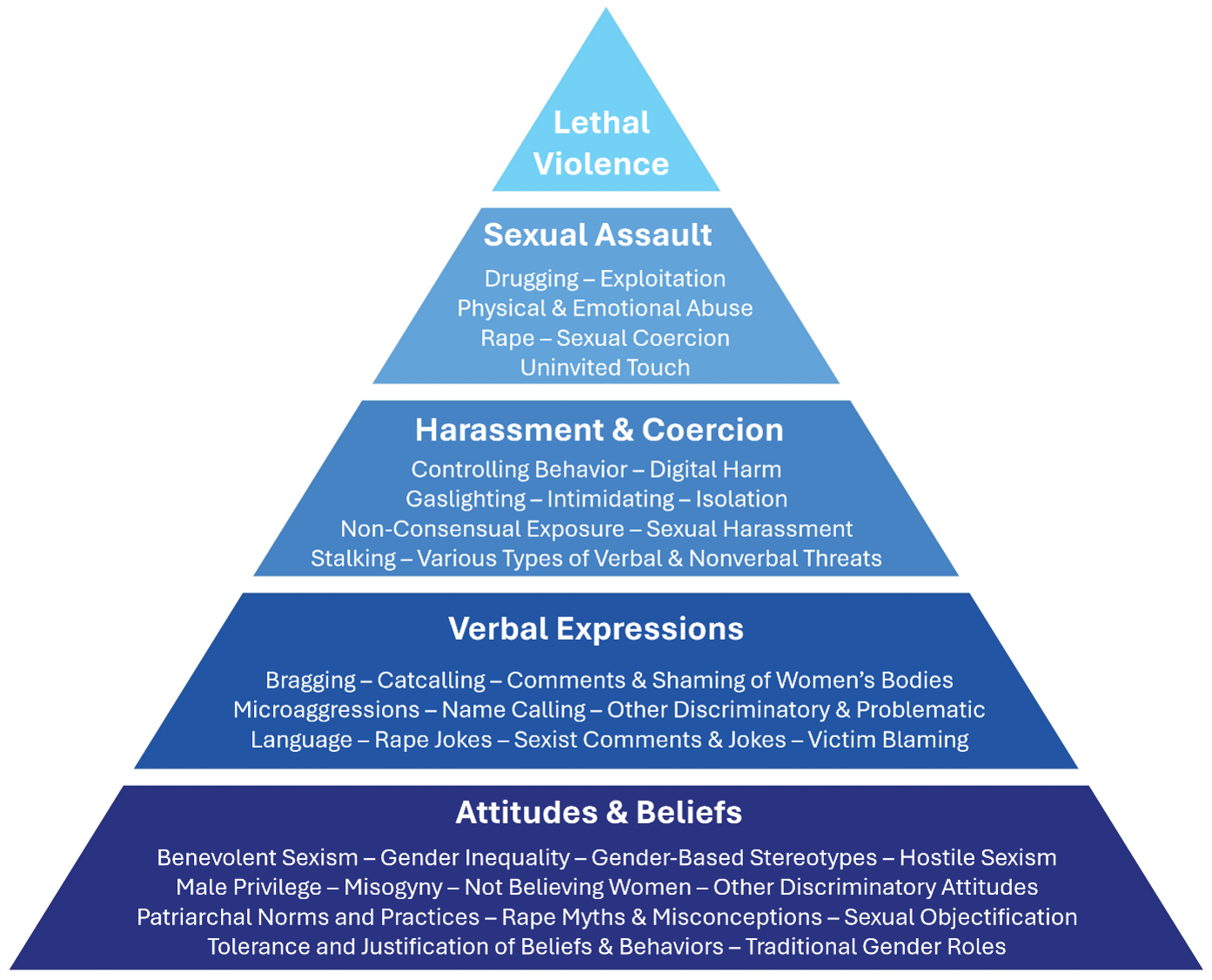
This section offers a high‑level overview of the Pyramid’s tiers and their interactions. The complete white paper provides a more extensive analysis, including detailed citations, methodological context, and additional examples, as well as fuller discussions of how elements within each tier connect to one another and how behaviors escalate across tiers—topics not covered in this article.
1. Attitudes & Beliefs: The foundational tier of the Pyramid—Attitudes & Beliefs—appears consistently across nearly all models reviewed in the literature. It reflects the cultural norms, assumptions, and stereotypes that legitimize inequality and justify entitlement. These beliefs position women as less credible, less autonomous, or less deserving of power and respect. They normalize gender inequality and create the worldview that makes higher‑tier behaviors possible.
Tier 1 includes 13 interconnected elements. Rather than functioning independently, they form a single ideological root system. In the white paper, I use the analogy of a tree: patriarchal norms form the deepest taproots; traditional gender roles and gender inequality act as the thick lateral roots; hostile and benevolent sexism, misogyny, male privilege, and sexual objectification operate as feeder roots; and rape myths, victim blaming, not believing women, and tolerance or justification emerge as the fine root hairs that draw these ideas into everyday interpretation and judgment.
Together, these linked beliefs form the deep root system from which sexual violence grows. For Latter‑day Saints, this tier is especially important to examine because cultural interpretations of gender roles—however well‑intended—can unintentionally reinforce some of these root patterns. Understanding Tier 1 is essential for discipleship, prevention, and accountability.
2. Verbal Expression: Tier 2—Verbal Expression—captures the outward verbal behaviors that reinforce power, degrade women, or test personal boundaries. Unlike Tier 1, which reflects internal beliefs, Tier 2 represents the spoken or written expressions that make those beliefs visible and socially reinforced. These behaviors signal, normalize, and communicate gendered power imbalances.
Tier 2 includes nine elements, such as catcalling, sexist comments and jokes, victim blaming, name‑calling, microaggressions, rape jokes, and comments about or shaming of women’s bodies. These expressions accumulate and interact, shaping social norms and signaling what is tolerated. They create an environment in which disrespect, dismissal, and boundary‑testing become normalized.
For Latter‑day Saints, Tier 2 is particularly relevant because our culture places a high value on kindness, respect, and clean speech. Yet harmful verbal patterns often persist quietly—sometimes dismissed as humor, personality, or “not a big deal.” In reality, Tier 2 behaviors are the bridge between belief and action, making inequality visible and harder to challenge.
3. Harassment & Coercion: Tier 3 marks a qualitative escalation: the movement from words to behavioral intimidation. These behaviors assert control, create fear, or violate autonomy. They may involve pressure, monitoring, isolation, or coercive control. Many operate without explicit verbal threats; instead, they rely on implication, surveillance, or manipulation.
Tier 3 includes nine elements that often co‑occur and escalate over time. Digital monitoring may accompany controlling behavior; intimidation may be paired with gaslighting; stalking may follow earlier verbal threats. These patterns collectively create a climate of fear and constraint that limits autonomy long before physical violence occurs.
In Latter‑day Saint communities—where trust, closeness, and shared social networks are common—Tier 3 behaviors can be harder to detect and easier to excuse. Yet they are critical warning signs that must be taken seriously.
4. Sexual Assault: Tier 4 represents direct violations of bodily autonomy through force, coercion, or incapacitation. These actions override consent, eliminate autonomy, and inflict profound physical, emotional, and psychological harm. Tier 4 behaviors do not merely signal a willingness to escalate—they are escalation.
Research shows that sexual assault frequently emerges in contexts where earlier‑tier behaviors have already normalized fear or diminished autonomy. As O’Sullivan and Ronis [9] noted, sexual aggression often follows a predictable social script: identifying, isolating, intimidating, and pressuring a target who does not consent, often within a social context where peers are aware of what is happening. This pattern mirrors the escalation described in the Pyramid. Tier 4 is not an isolated event—it is the outcome of earlier tiers left unchallenged.
5. Lethal Violence: Tier 5 represents the highest and most devastating point in the Pyramid: gender‑based violence resulting in death, including homicide and abuse‑related suicide. It is the gravest expression of gendered power and control.
In summary, the Pyramid is not abstract theory. It is a map of how violence grows and a warning that ignoring the lower tiers allows the upper tiers to flourish. With the framework established, it becomes possible to examine why Utah’s cultural and religious environment is uniquely vulnerable to certain upstream conditions.
Why Utah’s Context Matters
Utah’s religious and conservative culture brings many strengths: strong families, service‑oriented communities, and deep moral commitments. But research also shows that highly religious environments can unintentionally reinforce gendered power imbalances, discourage open discussion, and limit access to adequately funded prevention resources. Several patterns are especially relevant for Latter‑day Saints:
Patriarchal Norms and Gender Inequality: The Church teaches divine worth and equality before God. Yet cultural interpretations of gender roles—especially when rigid—can unintentionally privilege men’s authority and minimize women’s voices. When men are consistently positioned as leaders, decision‑makers, and spiritual authorities, it becomes easier for communities to dismiss women’s experiences or question their credibility.
Emphasis on Harmony and Forgiveness: Latter‑day Saints value unity, peace, and reconciliation. These are beautiful principles. But when misapplied, they can create pressure to “keep the peace” rather than confront harm. Survivors may be encouraged to forgive prematurely, avoid “causing contention,” or protect the reputation of individuals or institutions.
Stigma and Silence: Many survivors fear being blamed, disbelieved, or spiritually judged. They worry about disrupting social harmony or being seen as “less faithful.” Silence becomes a survival strategy—but it also allows harm to escalate.
Limited Public Funding for Prevention: Utah’s frontline organizations work tirelessly to support survivors, yet they do so with inconsistent and insufficient state funding. Prevention requires investment, and Utah has not yet made that investment at the scale needed.
These patterns rarely arise from malice; they emerge when cultural and religious systems unintentionally reinforce power imbalances and discourage open discussion. Recognizing them is not an attack on faith; it is an act of stewardship and care.
Why Sexual Violence Persists & A Path Toward Zion
The literature reveals several recurring insights that help explain why sexual violence persists across communities, including those with strong religious cohesion:
- Attitudes and Beliefs Matter: Violence begins long before physical harm. It begins with beliefs about who matters, who is credible, and who is entitled to power.
- Normalization Is Powerful: When harmful behaviors are minimized—“boys will be boys,” “he didn’t mean it,” “she’s exaggerating”—communities unintentionally create environments where more serious violations can occur.
- Systems Shape Outcomes: Social, cultural, institutional, and religious structures influence whose safety is prioritized and whose voices are believed.
- Violence Escalates: Microaggressions, boundary‑testing, and coercive behaviors are not separate from sexual assault—they are part of the same continuum.
- Silence Enables Harm: Shame, stigma, and fear of disrupting social harmony often prevent survivors from reporting and preclude effective community responses.
These findings underscore that sexual violence is not random; it emerges from predictable patterns that can be identified and disrupted. These insights help explain why Utah’s rates remain high despite strong families and religious cohesion. They also help us understand what must change.
Translating these insights into practice requires intentional cultural and institutional change. The following principles offer evidence based and theologically grounded approaches for Latter day Saints seeking to reduce harm and strengthen community resilience.
- Reject harmful gender norms. We must teach our sons and daughters that worth is equal, authority is shared, and leadership is relational—not hierarchical.
- Normalize conversations about abuse. Talking about sexual violence does not weaken faith. It strengthens it. Silence is not a gospel principle; truth is.
- Believe survivors. When someone discloses harm, our first response must be compassion, not skepticism. Belief is not judgment; it is support.
- Prioritize accountability over image. Protecting institutions at the expense of individuals is not Christlike. Accountability is a spiritual principle.
- Support prevention efforts. Advocate for funding, education, and community resources. Prevention is not political. It is moral.
- Teach healthy masculinity. Men and boys need models of strength rooted in empathy, humility, and partnership—not dominance.
- Create safe congregational cultures. Leaders must be trained, policies must be clear, and members must know how to report concerns without fear.
I have felt called to write about sexual violence for years. I have worked closely with organizations across the state who stand on the front lines of protecting women and children (and some men). It is difficult work. It is emotionally heavy. It is spiritually demanding. But if we do not learn where violence comes from, we cannot do better.
The question before us is simple: Can we build a society that is both deeply religious and also one of the safest places in the nation for women, children, and families? I believe the answer is yes, but only if we are willing to confront the roots of harm with honesty, humility, and courage.
Ultimately, confronting sexual violence is not peripheral to discipleship; it is central to building Zion. Research and doctrine converge on this point: communities flourish when they acknowledge harm, dismantle the conditions that enable it, and cultivate environments where every soul can thrive. [10]
Violence thrives in darkness. The gospel calls us to light. Yet, choosing the light requires deliberate, collective action. Let us protect our daughters, sons, sisters, brothers, neighbors, and friends. Let us build Zion—not only in aspiration, but in action.
NOTES:
[1] Madsen, S. R., & Clarkson, C. (2026, May 21). The current status of Utah women & girls: A 2026 research synopsis. Utah Women & Leadership Project. https://www.usu.edu/uwlp/files/wp/no-25.pdf --- [Back to manuscript].
[2] Madsen, S. R. (2026, June 23). The roots of sexual violence in Utah: A framework for understanding harm. Utah Women & Leadership Project. https://www.usu.edu/uwlp/files/wp/no-26.pdf
--- [Back to manuscript].
[3] UN Women consistently emphasizes that sexual violence is structural, arising from gender norms, patriarchal systems, and institutional dynamics. https://www.unwomen.org/en/publications --- [Back to manuscript].
[4] The Church of Jesus Christ of Latter-day Saints. (n.d.). Preventing and responding to abuse. https://www.churchofjesuschrist.org/study/manual/abuse-how-to-help/preventing-and-responding-to-abuse --- [Back to manuscript].
[5] Madsen, S. R. (2026, June 23). The roots of sexual violence in Utah: A framework for understanding harm. Utah Women & Leadership Project. https://www.usu.edu/uwlp/files/wp/no-26.pdf --- [Back to manuscript].
[6] Madsen, S. R. (2026, January 7). Why Utah still can’t confront violence against women. Utah News Dispatch. https://utahnewsdispatch.com/2026/01/07/why-utah-still-cant-confront-violence-against-women/ --- [Back to manuscript].
[7] Madsen, S. R. (2026, January 7); Madsen, S. R. (2026, February 16). How Utah’s faith communities can help end violence against women. Utah News Dispatch. https://utahnewsdispatch.com/2026/02/16/how-utah-faith -communities-can-help-end-violence-against-women/ --- [Back to manuscript].
[8] Madsen, S. R. (2026, June 23). The roots of sexual violence in Utah: A framework for understanding harm. Utah Women & Leadership Project. https://www.usu.edu/uwlp/files/wp/no-26.pdf --- [Back to manuscript].
[9] O’Sullivan, L. F., & Ronis, S. T. (2026). Isolate, inebriate, intimidate, repeat: High rates of sexual force against women are reported when young men are given anonymous surveys. Journal of Interpersonal Violence, 1–24. https://doi.org/10.1177/08862605261432630
--- [Back to manuscript].
[10] Madsen, S. R. (2026, June 23). The roots of sexual violence in Utah: A framework for understanding harm. Utah Women & Leadership Project. https://www.usu.edu/uwlp/files/wp/no-26.pdf --- [Back to manuscript].

Full Citation for this Article: Madsen, Susan R. (2026) "The Roots of Sexual Violence in Zion: Why Latter‑day Saints Must Confront the Conditions That Allow Harm to Persist," SquareTwo, Vol. 19 No. 2 (Summer 2026), http://squaretwo.org/Sq2ArticleMadsenZionViolence.html, accessed <give access date>.
 Would you like to comment on this article? Thoughtful, faithful comments of at least 100 words are welcome.